
AMR at a Turning Point: Key Insights from the BioInfect 2026 Conference
- Morula Health

- 1 hour ago
- 4 min read
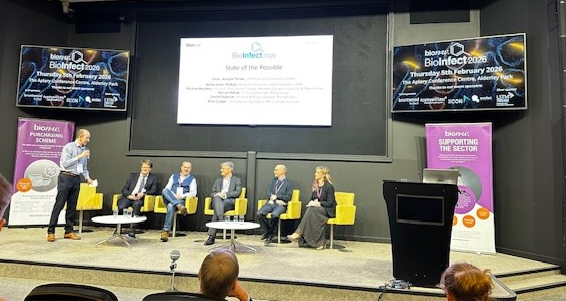
Last week, Morula Health attended BioInfect 2026, the annual infectious disease-focused event hosted by Bionow. This year’s program brought together academics, policy thinkers, biotech innovators, and public health leaders to confront a shared global challenge: how do we reduce the burden of infectious disease while ensuring antibiotics remain effective, accessible, and sustainably used?
Across panels, keynotes, and technical sessions, one message came through clearly: AMR is not a future threat, it’s a present and accelerating crisis, requiring aligned scientific, societal, and policy action. Below, we share the standout insights that matter most for small and emerging biotechs.
1. Infection Prevention & Control: The Most Immediate Solution
In his keynote, Mark Woolhouse, Professor of Infectious Diseases, Epidemiology, at the University of Edinburgh, highlighted what remains the simplest, most cost-effective intervention for reducing AMR: infection prevention and control (IPC). Better sanitation, hospital hygiene, and public health measures can dramatically reduce bacterial infections long before antibiotics are needed. The science shows that lack of sanitation and poor infection control, especially in low resource settings, drive far more deaths than antibiotic resistance itself.
This reframes the AMR conversation: reducing demand for antibiotics is as important as producing new ones.
2. Antibiotic Pipeline Reality: Innovative Science Meets Tough Economics
Several speakers stressed a well-known paradox: scientific discovery in new antimicrobials continues, but clinical adoption and market incentives lag far behind. While academic labs worldwide (including those represented at the conference) are uncovering novel antimicrobial mechanisms, very few reach clinical use because:
Market sizes remain small
New agents are often reserved as “last line solutions”
Reimbursement and incentive models are unfit for purpose
Development costs remain prohibitively high
Discussions around the UK’s “subscription” model for antibiotics highlighted the need for more aligned global incentives, especially as the UK market alone cannot sustain innovation.
3. Access and Equity: AMR Is Not One Problem — It’s Many
A compelling point from the keynote: AMR is a constellation of interconnected problems, not a single one. Different pathogens, terrains, antibiotic classes, and exposure ecosystems create a mosaic of resistance pressures.
One practical implication is often overlooked: In many parts of the world, lack of access to antibiotics still causes more deaths than resistance itself. The AMR challenge is therefore dual: ensuring access while promoting stewardship.
Conference speakers also emphasized that AMR is shifting demographically, from a problem primarily affecting young children to one disproportionately impacting older population. This shift has implications for surveillance, health economics, and treatment priorities.
4. Environmental and Agricultural Drivers: A One Health Reality
Surveillance in agricultural and environmental settings, to track and understand AMR transmission, is essential for predicting human health impact. The One Health perspective was reinforced repeatedly. Insights included:
Fungicide usage in crops may be silently accelerating antifungal resistance.
Antibiotics usage in livestock is a very large component of the global AMR ecosystem.
High resistance environments map onto clinical resistance patterns.
This wider perspective shows that effective AMR solutions require addressing both clinical (human) and agricultural antibiotic use, and involving pharma, biotech, agriculture, environmental governance, and global health policy stakeholders
5. AI in AMR Research: A Tool for Acceleration, Not a Silver Bullet
AI received a pragmatic assessment at BioInfect 2026. Speakers acknowledged that:
AI has real value in mining datasets, modelling resistance, and automating tasks such as drafting SOPs or supporting documentation.
Large pharma can rely on proprietary models, but smaller biotechs face real IP challenges when using public LLMs.
AI is best understood as an enabling technology, one that can shave time and cost from R&D, manufacturing, and data analysis, but cannot replace robust biological evidence.
For small biotechs, the most immediate opportunity is cost-saving operational support, including documentation, regulatory prep, and early-stage analysis.
6. Human Centered Communication: A Missing Link in AMR Progress
One of the conference’s most overlooked but vital themes was communication. Several panelists urged the field to shift the AMR narrative:
Use disease names the public recognizes (e.g., pneumonia) instead of technical AMR language.
Connect data to human stories to drive behavior change.
Position AMR education as a shared societal responsibility.
For small biotechs competing for partners, funding, and visibility, this point is crucial: clear, human centered communication is a strategic advantage, not an afterthought.
What This Means for Emerging Biotechs
From early-stage discovery companies to clinical stage innovators, AMR focused biotechs face:
Intense competition for attention and funding
Complex regulatory and evidence requirements
High documentation burden across R&D, clinical, and manufacturing functions
The need to articulate their value to investors, regulators, and health systems
What BioInfect made clear is that scientific excellence must be matched with communication that is timely, precise, and compelling.
This is where Morula Health specializes, helping biotechs turn complex science into actionable, regulatory ready, investor ready, and clinically relevant narratives. If your biotech team is ready to strengthen its scientific communication, accelerate documentation workflows, or bring clarity to complex clinical documentation, get in touch with the Morula Health team, we’d love to support your next steps.